
 Article
On February 10, 2026, Judge Rakoff of the United States District Court for the Southern District of New York answered that question with a “yes” in United States v Heppner.
Background
On November 5, 2025, Defendant Benjamin Heppner was arrested on securities and wire-fraud charges. During the investigation, the FBI seized documents, including 31 documents reflecting communications with the AI platform Claude.
The defendant claimed these documents were protected by attorney-client privilege, raising the question of first impression: “whether, when a user communicates with a publicly available AI platform in connection with a pending criminal investigation, are the AI user’s communications protected by attorney-client privilege or the work product doctrine?”
Attorney-Client Privilege
The court found that the communications were not privileged.
First, the court found that these communications were not communications between a client and a lawyer. The court reiterated that recognized privileges require “a trusting human relationship” and that no such relationship existed, or could exist, between an AI user and an AI platform.
Second, the court found that the communications were not confidential. In doing so, the court pointed to Claude’s written privacy policy, which explicitly states that the platform reserves its right to disclose data to third parties, defeating any reasonable expectation of confidentiality.
Finally, the court found that the defendant used the AI platform on his own initiative, not at the direction of counsel for purposes of obtaining advice.
Work Product Doctrine
The court also rejected work-product protection. The court found that, even assuming the AI documents were prepared in anticipation of litigation, they were not created at the direction of counsel and could not constitute work product.
Upshot
The decision highlights the privilege risks associated with using generative AI in connection with legal matters. Communications with public AI tools may not be confidential and may be discoverable. One open question is whether the court’s analysis would change if defense counsel had instructed Heppner to obtain information from Claude. But even then, a court might still find that disclosure of attorney-related information to a third-party AI platform waives privilege, particularly when the platform’s terms of service permit data disclosure, but that remains to be seen.
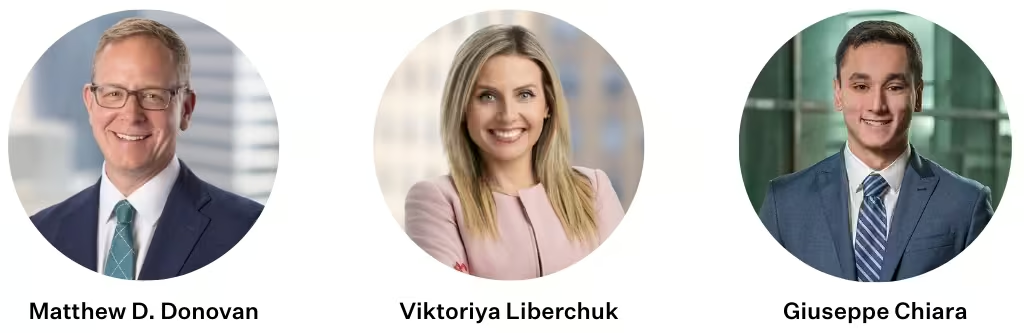
Matthew D. Donovan is a partner with Farrell Fritz in the firm’s New York City office. He practices in the areas of Commercial Litigation and Business Divorce.
Viktoriya Liberchuk is a partner with Farrell Fritz in the firm’s Uniondale office. She practices in the areas of Commercial Litigation, Business Divorce, and Insurance.
Giuseppe Chiara is an Associate with Farrell Fritz in the firm’s Uniondale office. He practices in the areas of Commercial Litigation and Labor & Employment.
